Quick start (if you’re impatient — I get it):
- Pick one platform + one broker and open a demo account first.
- Choose 1–2 pairs (majors are easiest) and a single timeframe (1H / 4H are beginner-friendly).
- Set a hard rule: risk 1% per trade, always with a stop-loss. No exceptions.
- Track every trade in a journal for 30 days before you “upgrade” your strategy.
Your first win is not a big profit — it’s building a process you can repeat.
Start here: the reality check
So, you want to trade Forex? Welcome. Grab a coffee — and let’s clear the fog first.
If you came here from social media, you’ve probably seen the “I made $10,000 before breakfast” clips.
Sure, big days happen. The problem is: big days aren’t a plan.
What you’re building is something repeatable — a process you can execute when you’re tired, busy, or slightly annoyed at your Wi‑Fi.
Think of Forex like learning to drive. At the start, it’s all mirrors and pedals and “wait, which one is the indicator?”
Later it becomes calmer — but only if you build good habits early.
Here’s the deal: the market doesn’t pay you for being excited. It pays you for being consistent.
Consistency comes from basics + risk management + a boringly repeatable routine.
Primary job
Survive
Protect capital first. Profit is a by-product.
Skill you’re training
Decision-making
Rules, not vibes. Process over outcome.
Biggest enemy
Emotion
Fear, greed, and “revenge trading.”
The basics: what are we actually doing?
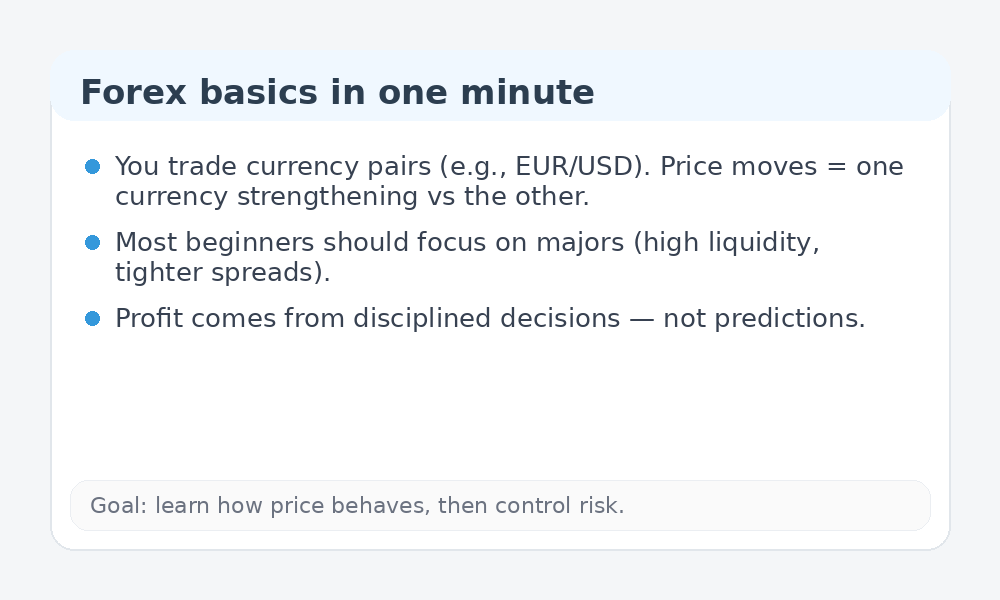
Quick refresher: pairs, majors, and the real goal for beginners.
At its core, Forex (foreign exchange) is about relative value. You’re always trading a pair:
one currency versus another.
Example: if you buy EUR/USD, you’re saying “I think the euro will strengthen versus the U.S. dollar.”
If EUR/USD rises after you buy, you profit. If it falls, you lose. Simple concept — complicated execution.
Two pieces that make everything click for beginners:
- Base vs. quote: in EUR/USD, EUR is the base (what you’re buying/selling) and USD is the quote (what it’s priced in).
- Long vs. short: “long” means buy the pair, “short” means sell it. You can do either.
And yes — prices move for reasons: interest rates, inflation, growth expectations, and “risk mood” (plus the occasional headline grenade).
Pairs and sessions (a tiny cheat sheet):
- Majors (most liquid): EUR/USD, GBP/USD, USD/JPY, USD/CHF, AUD/USD, USD/CAD, NZD/USD.
- Minors: major currencies without USD (e.g., EUR/GBP). Can be fine, just watch spreads.
- Exotics: involve emerging-market currencies. Higher spreads and bigger jumps — not ideal when you’re learning.
- When it moves: Forex trades 24/5, but volatility clusters around the London and New York sessions and major news releases.
Translation: start with majors during active hours. It’s easier to get clean fills and learn the “feel” of price.
Mini glossary
- Pip: the standard unit of movement (exact value depends on the pair and how it’s quoted).
- Spread: the difference between buy (ask) and sell (bid). One way brokers get paid.
- Leverage: borrowed purchasing power. Useful and dangerous — like a chainsaw in a kitchen.
- Stop-loss: a pre-set exit that limits damage if you’re wrong.
- Lot size: your trade size. This determines how much you win/lose per pip.
The “secret” most beginners miss: trading isn’t about predicting every wiggle.
It’s about managing a series of decisions where you keep losses small and let probability do its thing over time.
A healthy mindset shift: your job is not to be right. Your job is to be disciplined.
Traders can be wrong a lot and still make money because losses are controlled and winners aren’t cut early.
Step 1: the setup – choosing a broker and platform
Your broker is your gateway. That means two things: (1) they matter, and (2) you should be picky.
There are solid brokers out there — and there are brokers whose business model depends on clients making avoidable mistakes.
Broker checklist (print this mentally)
- Regulation: prefer brokers regulated by reputable authorities (and verify the license on the regulator’s website).
- Clear costs: know spreads, commissions, and overnight swap/financing for the pairs you’ll trade.
- Execution: slippage happens, but it shouldn’t be consistently “mysteriously” worse for you.
- Account types: standard vs. “raw spread + commission” accounts can change your all-in cost a lot.
- Leverage: more leverage is not “better.” It’s just more rope.
- Deposits/withdrawals + support: if withdrawals are slow or support dodges questions, treat it like a red flag.
Platform-wise, most retail traders start with MetaTrader 5 (MT5). It’s not pretty, but it’s reliable,
widely supported, and it has a huge ecosystem of indicators, scripts, and automation.
Beginner-friendly tip: choose one broker, one platform, and one or two pairs to start.
Too many moving parts early on makes it harder to spot patterns in your own behavior.
Step 2: the insider secret – stop overpaying
Trading has friction. Every time you enter and exit, you pay something — usually through the spread or a commission.
If you’re active, those costs can quietly become one of your biggest “expenses.”
Here’s what “cost” can include:
- Spread (the built-in buy/sell difference)
- Commission (often on raw-spread accounts)
- Swap/financing (if you hold positions overnight)
- Slippage (especially around news)
Quick example: if a pair has a 0.8 pip spread and your account charges a commission, your “all-in” cost can be closer to 1–2 pips round-trip once everything is counted.
That’s why a strategy with tiny targets (scalping) lives or dies on costs. Swing trades care less — but they still care.
One common way traders reduce effective costs is by using a rebate service like cashbkfx.com.
Think of it like cashback on trading volume. If you open your brokerage account through a rebate partner,
part of the broker’s referral fee may be shared back to you based on how much you trade.
Important: rebates don’t guarantee profits and shouldn’t change your risk rules. They’re a cost-reduction tool, not a strategy.
Transparency note: some links on this page may be affiliate links, which means the site may earn a commission at no extra cost to you.
Even if you break even on your trading, a small reduction in friction can meaningfully improve your long-term results.
Just read the terms and understand how/when rebates are paid.
Trading with only a chart is like trying to get fit without ever stepping on a scale.
You need tracking, feedback, and a way to see your habits clearly (especially the ones you’d rather ignore).
A performance dashboard that can connect to your trading account and show you your real stats:
drawdown, win rate, average win vs. loss, best/worst days, and more.
The big benefit is honesty. Our brains conveniently forget pain. A tracker doesn’t.
If someone is selling you signals or a course, a verified track record (and a healthy skepticism) matters.
If you use MT5, MQL5 is the main ecosystem for indicators, scripts, and “Expert Advisors” (automation).
It’s where you explore tools that can help you test ideas, enforce rules, or copy signals (with care).
Automation can reduce emotional mistakes, but it can also automate bad ideas faster. Start simple, test everything, and don’t trust marketing screenshots.
Even if you’re a “technical” trader, you still want to know when high-impact news is scheduled.
Big events can widen spreads, increase slippage, and turn a calm chart into a jump-scare.
Tip: decide in advance if you avoid trading 15–30 minutes before/after major releases (or if you have a specific news plan).
One more tool you should use: a trading journal
Not fancy. Just consistent.
Record: why you entered, where your stop was, how you sized it, what you felt, and whether you followed your rules.
If you do nothing else, do this — it’s the shortest path to improvement.
Journal prompt that works: “Would I take this trade again if nobody could see the result?”
If the honest answer is no, you just found your next habit to fix.
Trading can be lonely. That’s a feature and a bug. You don’t want groupthink, but you do want perspective.
The right communities can help you learn, spot scams, and avoid repeating mistakes that other people already paid for.
- Forex Factory: The economic calendar is a staple. Forums can be high signal — with the occasional grumpy veteran (don’t take it personally).
- BabyPips: Beginner-friendly education (“School of Pipsology”) and a welcoming community.
- Forex Peace Army: Useful for broker/service reviews and scam investigations. Research before you deposit anywhere.
- Trade2Win: Broad trading discussions beyond Forex too — helpful for widening your lens.
Step 5: developing a strategy (the “boring” part that makes money)
A strategy is not “I feel like it’s going up.” A strategy is a repeatable set of rules:
when you enter, where you get out if wrong, where you take profit,
and how much you risk.
Two underrated rules that separate “a plan” from “a vibe”: when you don’t trade (news windows, low liquidity, your own fatigue)
and what counts as a valid setup (so you’re not redefining it mid-trade).
The two big approaches
- Fundamental analysis: you trade based on macro drivers (rates, inflation, jobs data, growth expectations).
- Technical analysis: you trade based on price behavior (support/resistance, trends, ranges, patterns).
Most real-world traders blend the two. For example: you may prefer a technical entry, but you avoid trading right before major news.
That’s not “being afraid.” That’s being professional.
Rule #0: know when you don’t trade.
- Right before high-impact news if you don’t have a specific news plan.
- When you’re tired, angry, or trying to “win it back.”
- When your setup isn’t there. “No trade” is a position.
Most beginner losses are avoidable. Your edge can be as simple as refusing bad conditions.
A simple “starter” strategy idea (not a promise, just a structure):
- Pick 1–2 major pairs (EUR/USD, GBP/USD, USD/JPY are common).
- Trade one timeframe consistently (e.g., 1H or 4H) so you’re not switching personalities mid-week.
- Define a trend filter (e.g., higher highs/higher lows) and an entry trigger (e.g., pullback to a key level).
- Use a stop-loss placed where your idea is clearly invalid — not where your emotions feel comfortable.
- Journal every trade for 30 days before changing rules.
One concept worth learning early is expectancy — it’s the math behind whether a strategy has an “edge.”
In plain English: a strategy can work with a modest win rate if your winners are bigger than your losers.
Expectancy (plain math):
Expectancy = (Win% × Avg Win) − (Loss% × Avg Loss). If it’s positive over a meaningful sample, you’ve got something worth refining.
Quick sanity check: if your average win is $30 and your average loss is $20, you don’t need a 70% win rate.
You just need your rules to keep losses controlled and winners consistent. That’s why journaling matters.
Risk management (the part that keeps you in the game)
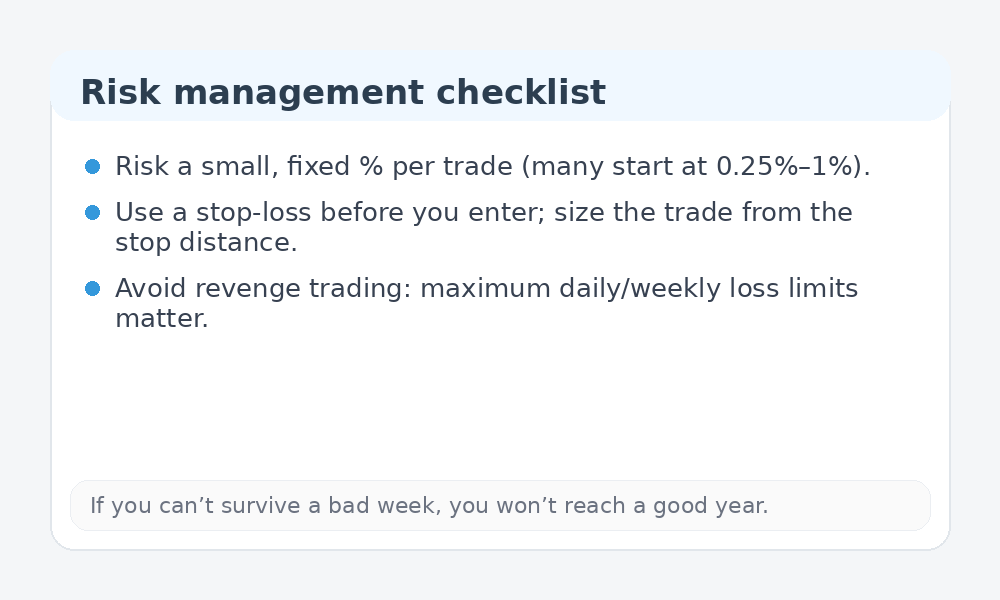
A simple checklist to protect your account while you learn.
If you only remember one thing from this article, make it this: risk is the steering wheel.
Without it, you’re not “trading,” you’re just sliding around on ice and hoping for the best.
The golden rule
Many experienced traders risk about 1% to 2% of their account per trade.
That means if you have $1,000, you plan to lose $10–$20 if your stop-loss is hit.
Position sizing (simple version):
Risk amount = Account size × Risk %. Then choose a stop-loss distance.
Your position size is whatever makes that stop-loss equal your risk amount.
Quick example: $1,000 account × 1% risk = $10. If your stop is 20 pips away, you want your position sized so that
20 pips ≈ $10 (about $0.50 per pip). Don’t guess — use a calculator until this is automatic.
Why this matters: if you risk 10% per trade, a short losing streak can end your trading career.
If you risk 1%, you can be wrong many times in a row and still survive long enough to learn.
Three rules that save accounts
- Always use a stop-loss. Not “mental.” Not “I’ll close it if it gets bad.” A real stop.
- Size your trade from the stop-loss. Stop distance first, lot size second. Not the other way around.
- One bad day should not become a bad month. Have a daily loss limit (e.g., 2–3 losses and you stop).
Step 6: the transition from demo to live
Demo accounts are useful for mechanics and practice, but they lie emotionally.
Losing fake money doesn’t hurt. Losing real money changes your breathing, your decision-making, and your patience.
Best move for beginners: when you go live, trade smaller than you think you should.
You’re not trying to get rich. You’re training your nervous system to follow rules under pressure.
If you have $5,000 set aside, consider starting with a smaller portion (for example, $500) and scale only after you’ve proven consistency.
Scaling is a reward for discipline — not confidence after a lucky week.
Another beginner-friendly option is a micro/cent-style account (where available), so you can trade real money with tiny risk.
The goal is to practice behavior: following rules under pressure.
A simple weekly routine for beginners
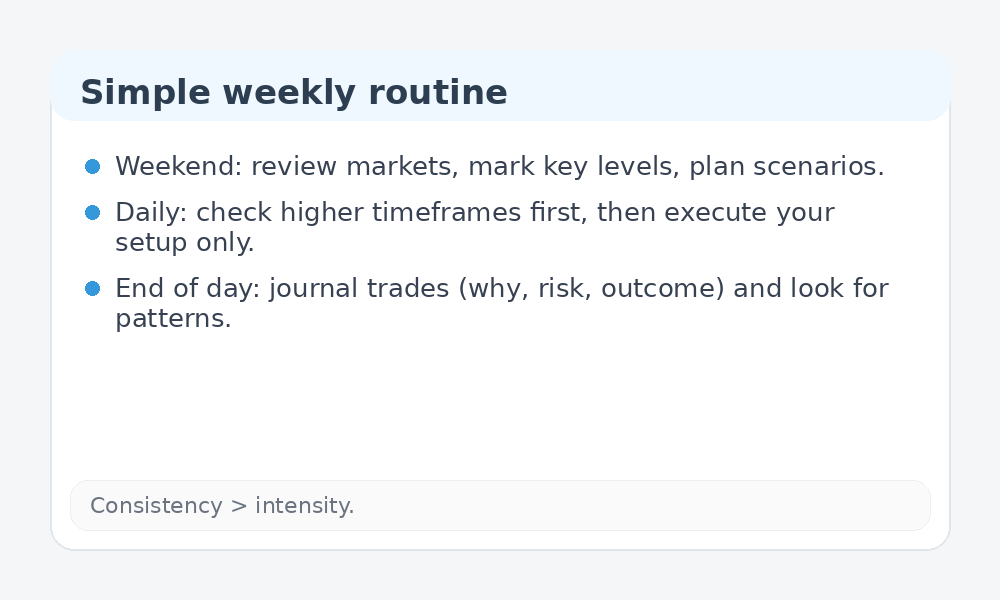
A repeatable weekly cadence helps you improve faster with less stress.
The fastest improvement usually comes from doing the basics consistently. Here’s a routine that keeps you grounded:
- Sunday / Monday: review the economic calendar (big rate decisions, CPI, jobs data).
- Daily (10–15 min): mark key levels on your chosen pairs. Decide your “if/then” plan.
- During trading: only take trades that match your rules. No “just this once.”
- After trading: journal the trade (setup, entry, stop, size, emotion, rule adherence).
- Weekly review: look for one fix. Not ten. One. Then apply it next week.
Common beginner mistakes (and how to avoid them)
- Overtrading: more trades ≠ more skill. Usually it’s just more fees and more emotional whiplash.
- Changing strategies every week: you never collect enough data to know what works for you.
- Moving the stop-loss: that’s not “giving it room.” That’s negotiating with the market.
- Chasing losses: revenge trading turns a normal loss into a catastrophe. Step away.
- Ignoring costs: spreads and commissions matter. Treat them like business expenses.
- Averaging down without rules: adding to a losing trade can turn “manageable” into “unrecoverable” fast.
- Holding overnight blindly: check swap/financing. Some pairs can bleed you slowly even if price goes nowhere.
- Following strangers blindly: learn from others, but keep responsibility for your own risk.
- Trading big news without a plan: volatility is fun until it’s your stop getting skipped.
- Not reviewing: if you don’t review, you repeat. If you review, you improve.
FAQ
How much money do I need to start?
You can start with a small amount, but you need enough that proper position sizing is possible.
The real answer is: start with what you can afford to lose while you learn — and keep risk per trade small.
How much leverage should I use?
As little as you can get away with. Leverage isn’t “extra profit” — it’s extra exposure.
If you’re sizing positions correctly (based on a stop-loss and a fixed risk %), you’ll rarely need high leverage.
How do I avoid scams?
Use a boring checklist. Scams hate boring checklists.
- Verify regulation on the regulator’s official website (don’t trust a logo on a landing page).
- Be suspicious of guarantees (“no losses”, “fixed monthly returns”, “secret bank strategy”).
- Test withdrawals early with a small amount before you scale up.
- Demand transparency: real track record, real drawdowns, and clear risk rules.
How long does it take to get good?
Longer than most ads suggest, and faster than you think if you’re consistent.
If you treat it like a skill — practice, journal, review — you can make real progress in a few months.
Profitability is a different question because it depends on discipline, time, and the market environment.
Can I trade Forex as a side hustle?
Yes, if you choose a timeframe that matches your schedule. Many part-time traders prefer higher timeframes (like 4H or Daily)
so they don’t have to watch every tick.
Is copying signals a good idea?
It can be, but treat it like hiring a contractor: verify their history, understand their drawdowns, and keep risk low.
If you don’t understand how the strategy wins and loses, you won’t know when it’s failing.
What’s the “best” strategy?
The best strategy is the one you can follow consistently, with risk controlled, through both winning and losing streaks.
A good strategy on paper is useless if you can’t execute it.
Final thoughts
Forex trading can offer flexibility and independence — but you have to earn it.
Treat it like a business: reduce unnecessary costs, track performance, learn relentlessly, and protect your capital like it’s oxygen.
Use tools like Myfxbook to stay honest,
explore the ecosystem on MQL5 if you use MT5,
and lean on quality communities when you’re stuck.
If a rebate program like cashbkfx.com fits your setup,
it can reduce friction — just keep it in the “expenses” category, not the “edge” category.
Crypto starter guide
How to start crypto trading: a calm route for beginners
Crypto trading is much easier to start when you stop treating it like a shortcut. The market is open all day, prices can move violently, and a good-looking chart can still punish an impatient trader. The first goal is not to catch the next miracle coin. It is to learn how orders, fees, liquidity and risk behave when real money is on the screen.
Use the first month as training, not as a race. Build a small routine, write down every decision, and let Bybit or any other exchange be a tool in that routine rather than the whole plan. A clean platform helps; discipline does the heavy lifting.
Start with the market, not with a hot tip
Before you deposit, learn the difference between spot trading and leveraged products, why stablecoins are used as settlement currency, how order books work, and why a coin with a thin market can jump or fall faster than you expect. Pick a few liquid pairs, watch them for several days, and notice how news, funding rates and broad market mood change the chart.
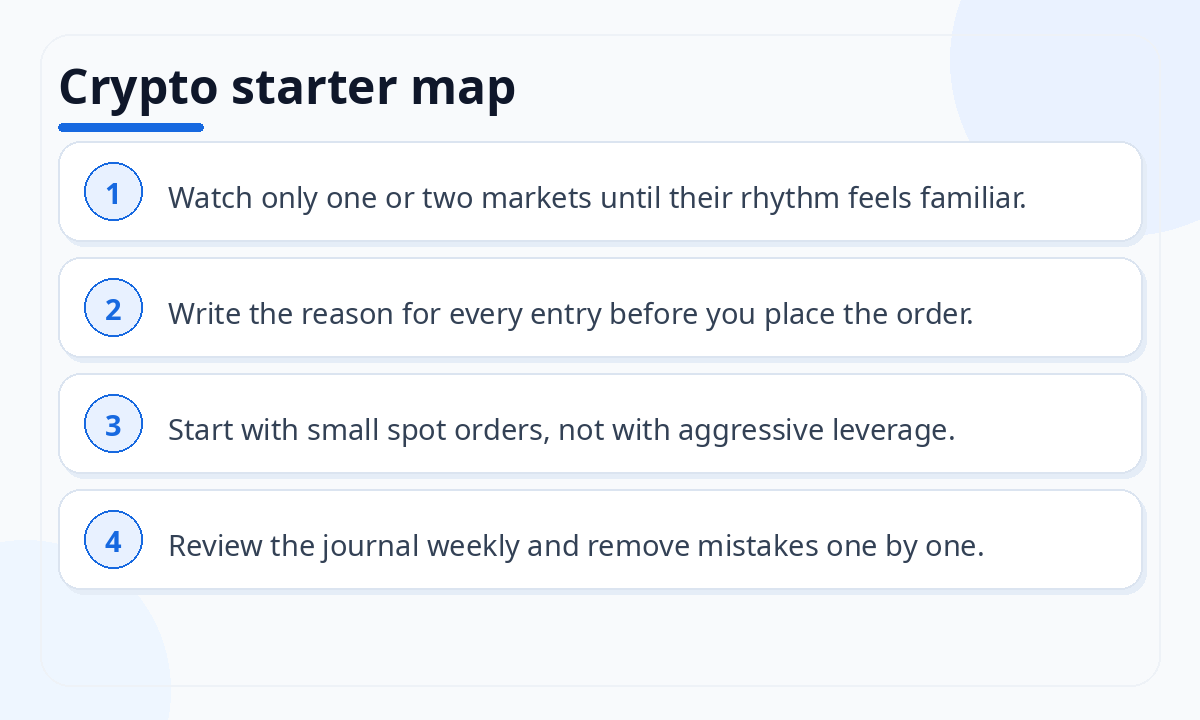
A simple learning map: study first, test small, write down every decision, and review your numbers.
Build a routine you can repeat
A beginner does not need ten indicators and twenty chat groups. One repeatable process is better. Decide when you check the market, what conditions must exist before you enter, where the idea becomes wrong, and when you will step away. Boring habits are what keep you from clicking just because the candle is moving.
- Watch only one or two markets until their rhythm feels familiar.
- Write the reason for every entry before you place the order.
- Start with small spot orders, not with aggressive leverage.
- Review the journal weekly and remove mistakes one by one.
Put risk management before every signal
No setup is worth much if one bad trade can damage the account. Many careful traders risk a small fixed part of their capital on each idea and accept that some trades will lose. A stop level, a position size and a maximum daily loss should be written before the order is opened, not after the price starts moving against you.
- Use money you can truly afford to lose while learning.
- Define the maximum loss before every trade.
- Avoid revenge trades after a loss or a missed move.
- Keep only the balance you need for trading on an exchange.
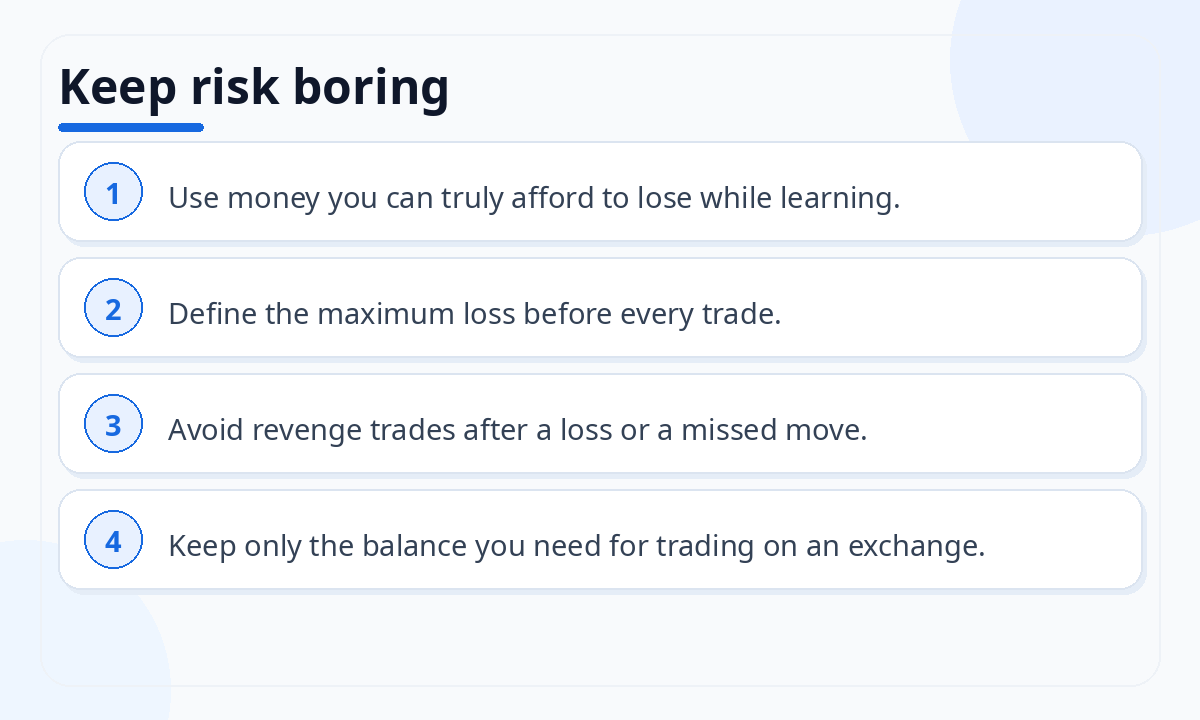
Risk rules should be simple enough to follow on a stressful day.
Where Bybit can fit into the process
Bybit is a centralized cryptocurrency exchange launched in 2018. It has developed from a derivatives-focused venue into a wider trading platform with spot markets, derivatives and other crypto services. What you can use depends on your region, verification level and the current product rules, so always check the available services inside your own account.
For a beginner, Bybit is useful when it gives you a clear order screen, liquid markets, visible fee information, account security settings and reserve transparency. None of those features makes trading safe by itself. They only help if you trade small, protect the account, and learn how each order type works before using bigger size.
- Use the official Bybit link and check regional availability.
- Complete identity verification and enable two-factor protection.
- Begin with simple spot trades and a small deposit.
- Make a small test withdrawal before increasing the balance.
Useful Bybit pages to check
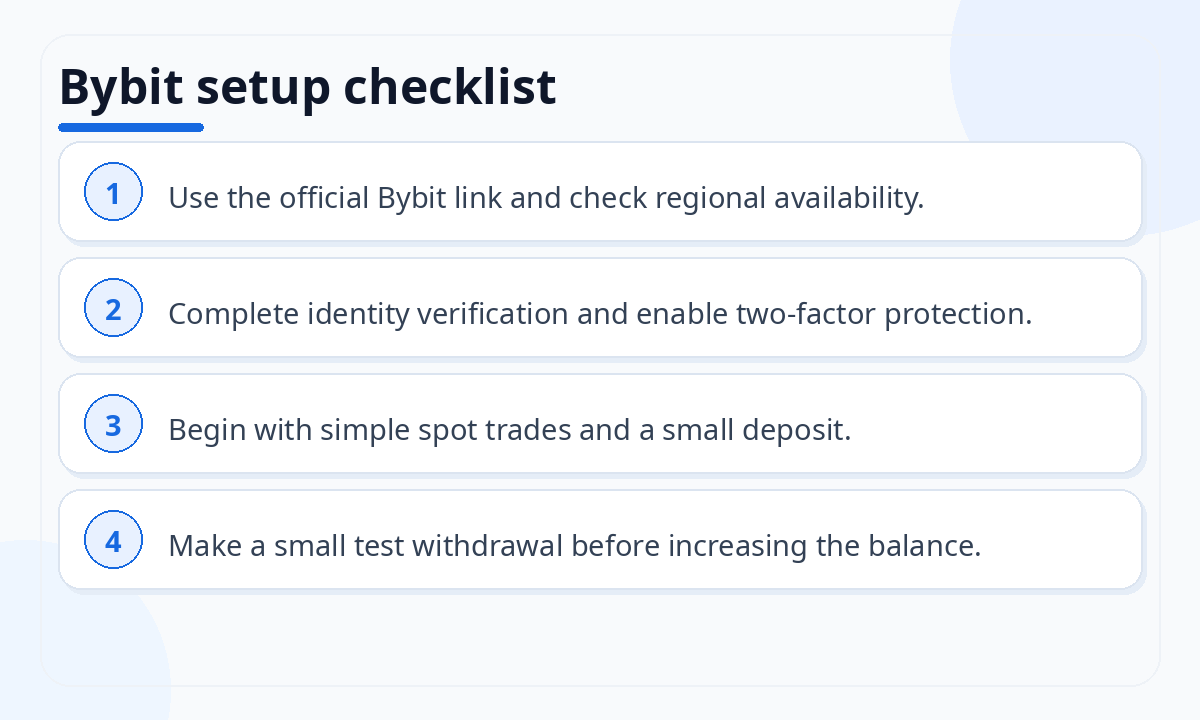
A beginner-friendly setup: official link, verification, security, small deposit and test withdrawal.
Do the boring checks before your first deposit
Before you send money anywhere, slow down and check the unglamorous details: the web address, the deposit network, withdrawal limits, fees, and whether the service is available where you live. A tiny test deposit and a tiny test withdrawal teach more than any screenshot in a chat group. Note the network you used, the fee, and how long the transfer took. It feels slow only until it saves you from an expensive mistake.
- Bookmark the official exchange address instead of relying on ads or random links.
- Check that the coin and the network match on both sides of the transfer.
- Do one small deposit and one small withdrawal before moving serious money.
- Keep tax records and download statements while they are easy to find.
Read the order screen like a contract
The order ticket is not a button to press in a hurry. It shows the pair, order type, size, estimated fee and, when leverage is involved, the price where the trade can break. Pause before you tap buy or sell. If you cannot explain the idea in one plain sentence, the trade is probably not ready.
- Use limit orders when the spread is wide or the market is thin.
- Be careful with market orders during news, fast candles or low liquidity.
- Check the base coin, quote coin and order size before confirming.
- Cancel old orders if your original plan is no longer valid.
Make your journal honest
A trading journal is not a trophy album. It is where you catch the habits you do not notice in the moment. Write down the reason for the trade, your mood, the size, the invalidation point, the result and one lesson. After ten or twenty trades, the notes will show whether you are following a plan or simply reacting to noise.
A practical first-month plan
The best first month is quiet. You are gathering evidence about yourself: whether you chase, whether you cut losses, whether fees matter to your style, and whether you can follow a plan when the market becomes loud.
- Week 1: learn the basic terms and watch charts without trading.
- Week 2: place only tiny spot orders and record every fee.
- Week 3: test one simple strategy with written entry and exit rules.
- Week 4: review the journal, keep what works and reduce what hurts.
Common mistakes that cost beginners money
Most early losses come from ordinary behaviour, not from a lack of secret information. The trader gets excited, increases size, changes the plan mid-trade, or keeps coins on an exchange without a security routine. Fixing these habits is less glamorous than finding a new indicator, but it matters more.
- Chasing a fast green candle because everyone online is talking about it.
- Using high leverage before you can manage normal spot risk.
- Adding to a losing position without a written reason.
- Treating an exchange account as a long-term savings wallet.
Final thought
Crypto trading can be interesting, flexible and intellectually addictive, but it rewards patience more than bravado. Learn slowly, keep records, use Bybit’s tools deliberately, and judge progress by better decisions before you judge it by profit.
Educational content only, not financial advice. Crypto assets can lose value quickly; check local rules and trade only with money you can afford to lose.